How to Clean a Bathroom Top to Bottom in 30 Minutes
Clean your bathroom top to bottom in 30 minutes with a smart order of work: spray first, then mirror, sink, tub, toilet last, and floor.
You can clean a whole bathroom properly in about 30 minutes if you work in the right order: spray the toilet and tub first so the cleaner can sit while you do everything else, then work top to bottom and dirty-to-dirtier — mirror, sink, tub or shower, toilet, and floor last. The trick isn’t scrubbing harder. It’s letting products do the waiting for you and never backtracking over a surface you’ve already cleaned.
Here’s the exact sequence, the timings, and the safety notes that actually matter.
Before you start (2 minutes)
Open the window or turn on the exhaust fan. You want airflow the whole time, especially if you’re using bleach or any disinfectant. Ventilation keeps fumes down and helps surfaces dry faster afterward.
Grab your supplies so you’re not running back and forth. You don’t need much:
- An all-purpose cleaner or bathroom spray
- A disinfectant (spray or wipes) for high-touch spots and the toilet
- A toilet bowl cleaner and a toilet brush
- Glass cleaner (or just water and a flat-weave cloth) for the mirror
- Two or three microfiber cloths in different colors
- A scrub sponge
- Rubber gloves
- A floor cloth or mop
The colored cloths matter. Pick one color for the toilet and one for the sink and other surfaces, and never swap them. This is the single easiest way to avoid spreading bathroom bacteria onto the places you touch with clean hands. If you’re building a kit from scratch, see our starter list of cleaning supplies you really need.
One safety rule before anything goes in a bottle or bowl: never mix bleach with vinegar, ammonia, or other cleaners. The combination can release dangerous gases. If you’re ever unsure what’s safe to combine, check our guide to cleaning products you should never mix.
Clear the decks
Quickly move loose items off the counter, the tub edge, and the floor — bath mats, bins, toiletries, the trash can. You can’t clean around clutter in 30 minutes. Shake out the bath mat and set it aside to go in the wash later.
The 30-minute order of work
| Step | Task | Time |
|---|---|---|
| 1 | Spray toilet bowl + tub/shower, let dwell | 2 min |
| 2 | Mirror and any glass | 3 min |
| 3 | Sink and counter | 5 min |
| 4 | Tub and shower | 7 min |
| 5 | High-touch surfaces (handles, switches) | 3 min |
| 6 | Toilet, inside and out | 5 min |
| 7 | Floor | 5 min |
That’s 30 minutes with no backtracking. The order is deliberate: top surfaces before low ones so drips fall onto dirty areas you haven’t done yet, and the toilet near the end so you only handle it once, right before the floor.
Step 1: Spray first, then walk away (2 minutes)
Squirt toilet bowl cleaner around the inside rim of the toilet so it runs down the bowl. Then spray your bathroom cleaner on the tub walls, shower, and any soap-scummy tile. Leave both to sit.
This “dwell time” is the part most people skip, and it’s doing real work. Cleaners need a few minutes in contact with grime to break it down, which means far less scrubbing for you. By the time you circle back, the toilet and tub are half-done.
Read the label for contact time. This is especially important for disinfectants. A product only kills germs if the surface stays visibly wet for the full time the label states — often somewhere between 1 and 10 minutes depending on the product. If it dries too fast, reapply. The American Cleaning Institute and the US EPA both stress that contact time is what makes disinfecting work; wiping a surface the instant you spray it mostly just moves germs around. For more on the difference, see cleaning vs disinfecting.
Step 2: Mirror and glass (3 minutes)
Do the mirror while your hands are cleanest and the surface is still dry. Mist glass cleaner lightly — or use plain water — and wipe with a dry flat-weave microfiber cloth in an S-pattern. Buff any streaks with a dry corner of the cloth.
Don’t spray cleaner directly at the edges of the mirror. Liquid can seep behind and damage the backing over time. Spray the cloth instead, then wipe.
If there’s toothpaste spatter or hairspray film, a damp cloth first, then the glass cloth, gets it clear.
Step 3: Sink and counter (5 minutes)
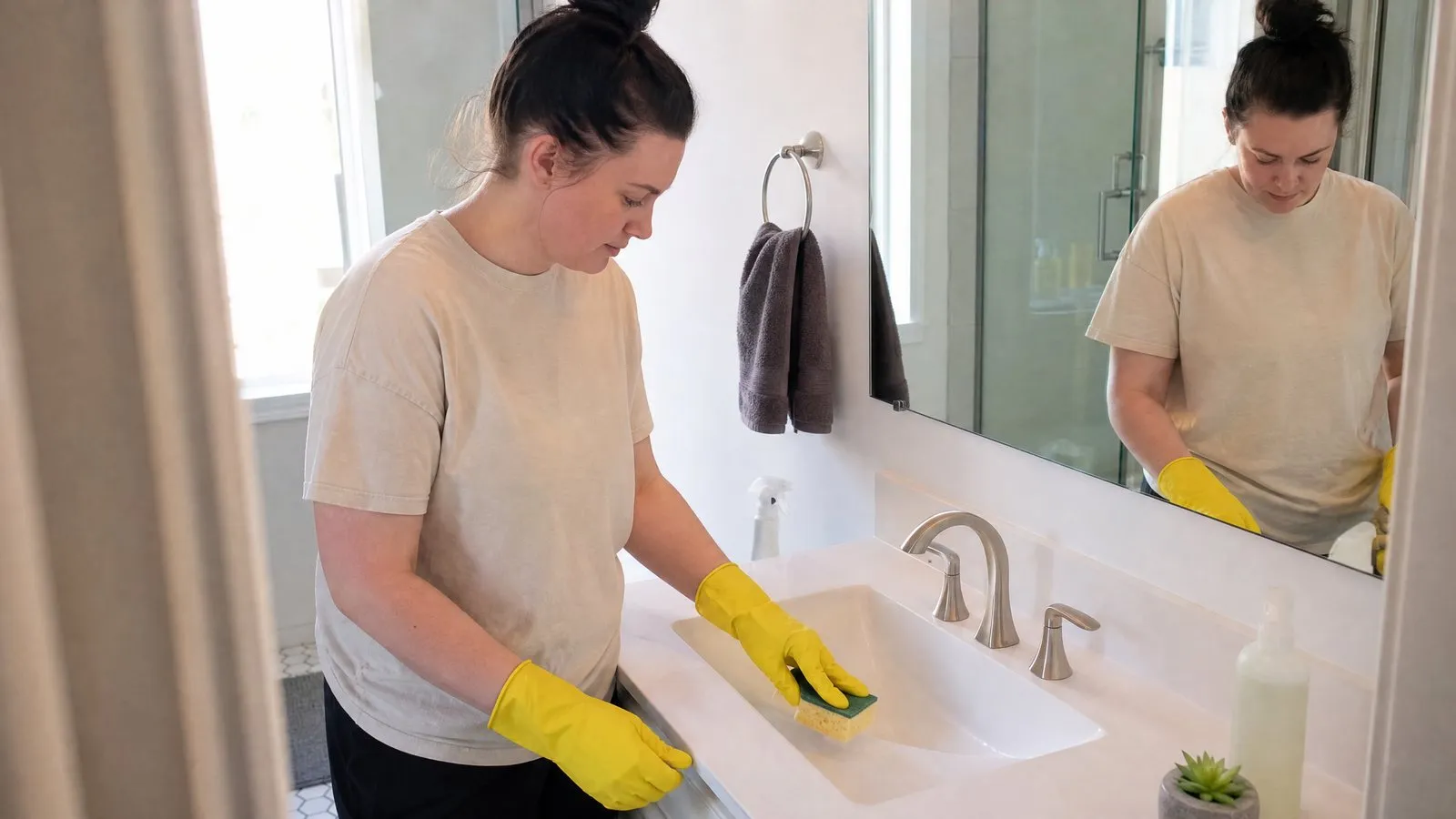
Wet the sink, then wipe the counter and basin with your all-purpose cleaner and the sink-colored cloth. Work from the back of the counter forward and from the top of the faucet down.
- Wipe the faucet, handles, and the base where gunk collects.
- Clean the basin, then the drain and overflow holes.
- For hard-water spots or a dull chrome faucet, a cloth dampened with diluted white vinegar cuts mineral buildup well. Just keep vinegar off natural stone like marble or granite, and off any unsealed stone — it etches the surface. Our guide on cleaning with vinegar covers where it helps and where it harms.
Rinse the basin and wipe it dry so it shines. Put toiletries back as you go so the counter isn’t cluttered again.
Step 4: Tub and shower (7 minutes)
Your earlier spray has been sitting for several minutes now, so the soap scum should wipe off with much less effort. Scrub the tub floor, walls, and any tile with the sponge, working top to bottom.
- Pay attention to corners and the strip of grout where the wall meets the tub — that’s where mildew starts.
- Wipe down the shower door or rinse the curtain liner.
- Clean the taps, shower head, and any shelves or caddies.
- Rinse everything thoroughly with warm water, either with the shower head or a cup of water, so no cleaner residue is left behind.
If you’re already seeing black or pink mildew in the grout and caulk, a quick scrub won’t fully fix it — you’ll need a targeted approach from our guide on getting rid of mold and mildew in the shower. To slow it coming back, leave the fan running or window open for a while after showers so the room dries out.
Step 5: High-touch surfaces (3 minutes)
Before you move to the toilet, hit the spots hands touch most, using your disinfectant and the sink-colored cloth (or disposable wipes):
- Light switches
- Door handle and the door edge around it
- Faucet handles (again, lightly)
- Towel bar and toilet-paper holder
Spray or wipe these and let them stay wet for the contact time on the label. These small surfaces carry more germs than the places we scrub hardest, and they take under a minute each.
Step 6: The toilet, inside and out (5 minutes)
Now the toilet, and only now, because it’s the dirtiest fixture. Switch to your toilet-colored cloth and keep it separate from everything else.
Inside the bowl:
- Scrub the inside with the toilet brush, getting right up under the rim where the cleaner was poured earlier.
- Work the brush down into the throat of the bowl, below the waterline.
- Flush while holding the brush in the stream to rinse it, then let it drip-dry propped between the seat and the bowl before returning it to its holder.
Outside the toilet:
- Spray disinfectant over the whole outside — tank, handle, lid, seat (both sides), base, and the floor around the base.
- Let it sit for the label’s contact time.
- Wipe from cleanest to dirtiest: handle and tank first, then lid, then seat, then the base and the floor behind it last.
The base and the floor behind the toilet are where odors hide, so don’t skip them. When you’re done, that toilet cloth goes straight into the laundry — never reuse it on another surface, and wash it separately from kitchen cloths. A reminder on keeping products safely out of reach if you have little ones: see storing cleaning supplies safely with young children.
Step 7: The floor, last (5 minutes)
Floors come last because every earlier step dropped dust, hair, and overspray down here. Working any other way means cleaning the floor twice.
- Sweep or dry-dust the floor, getting hair out of corners and behind the toilet and door.
- Mop or wipe with your floor cloth and a little all-purpose cleaner, starting at the far corner and working back toward the door so you don’t walk over wet floor.
- Wipe the baseboards and the bottom of the door if you have a few seconds.
Leave the floor to dry before putting the bath mat and bin back. Hang your used cloths and the bath mat to wash, open the window a little longer, and you’re done.
Keep it to 30 minutes next time
The reason a weekly bathroom clean stays fast is that nothing builds up. A quick daily wipe of the sink and a squeegee of the shower door takes seconds and saves you the hard scrubbing later — that’s the idea behind our daily habits that keep a home clean. If you’d rather spread chores across the week instead of one big session, our 20-minute-a-day weekly schedule folds the bathroom into a routine, and the free weekly cleaning plan tool builds one around your days.
If you’re pressed for time across the whole home, the same spray-and-dwell logic powers our 1-hour speed clean.
FAQ
How long should disinfectant sit before I wipe it off?
Follow the contact time printed on the product label — it’s usually between 1 and 10 minutes, and it varies by product. The surface has to stay visibly wet that whole time for the disinfectant to work. If it dries early, spray again. The US EPA and the American Cleaning Institute both note that contact time is what actually kills germs, not the wiping.
Why clean the toilet last instead of first?
Two reasons. The toilet is the dirtiest fixture, so doing it last means you handle it once, right before the floor, without risking spreading bacteria to cleaner surfaces. And because you sprayed it at the very start, the cleaner has had the longest dwell time, so the bowl needs less scrubbing.
Do I really need separate cloths for the toilet and sink?
Yes. Using one cloth everywhere spreads toilet bacteria to the sink and counter you touch with clean hands. Keep different-colored cloths for each job, send them to the wash after use, and wash bathroom cloths separately from kitchen ones.
Can I use the same spray on everything?
Mostly, but watch two things. Keep vinegar and acidic cleaners off natural stone counters, which they can etch. And never combine bleach with vinegar, ammonia, or other cleaners — the fumes can be dangerous. When in doubt, stick to one all-purpose cleaner and one disinfectant, and ventilate the room.
How often should I deep clean the bathroom versus this quick clean?
This 30-minute routine works well once a week. Every month or two, set aside extra time for the jobs this pace skips — descaling the shower head, scrubbing grout, cleaning the exhaust fan cover, and wiping inside cabinets. Our deep cleaning checklist lists them all.