How to Clean a Mattress and Get Rid of Stains and Odors
Clean your mattress in under an hour: vacuum, deodorize with baking soda, spot-clean stains with little moisture, dry fully, then protect and rotate it.
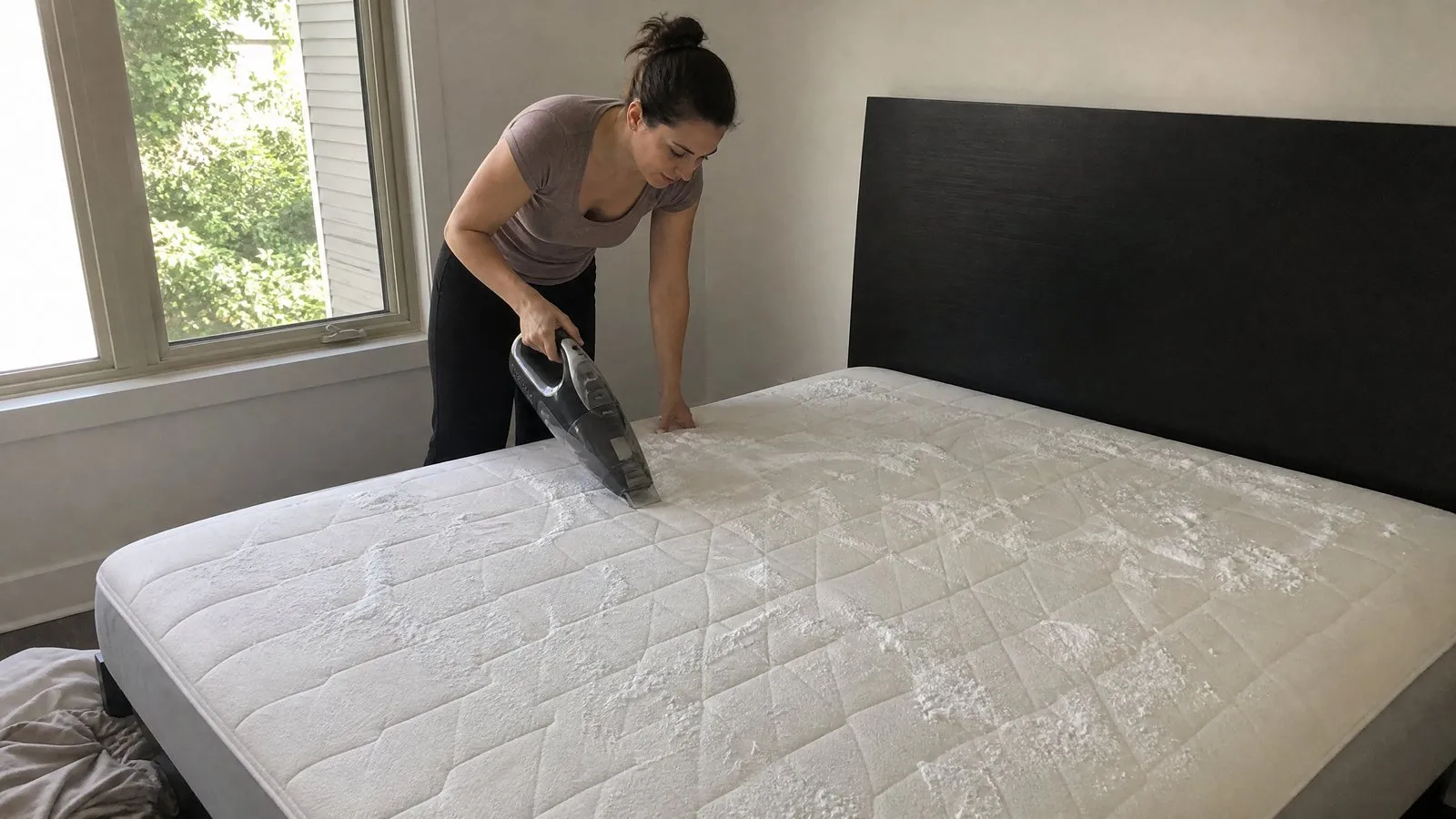
You can refresh most mattresses in about 45 minutes of hands-on work: vacuum it, sprinkle baking soda and let it sit, spot-clean any stains with as little liquid as possible, then let it dry completely before you put bedding back. The key rule is simple — go light on moisture. Mattresses hold water deep inside the foam and springs, and water that can’t escape is what causes mildew and lingering smells.
Here’s exactly how to do it, plus how to keep it clean with a protector and regular rotation.
What you’ll need
Nothing fancy. Most of this is in a basic cleaning starter kit.
- Vacuum with an upholstery or crevice attachment
- Baking soda (a cup or two)
- A fine-mesh strainer or just the open box, for even sprinkling
- Two clean white cloths or microfiber towels (white so you can see what lifts out)
- Dish soap, or an enzyme cleaner for protein and pet stains
- A spray bottle or small bowl of water
- Hydrogen peroxide (3%) for tougher stains, optional
- A fan, and an open window if you have one
Set aside about an hour total, though most of that is waiting while baking soda and drying do the work.
Step 1: Strip the bed and wash everything
Pull off sheets, pillowcases, mattress protector, and any mattress topper cover. Wash them on the hottest setting the care labels allow — hot water helps with dust mites and sweat buildup. If you’re unsure what a symbol means, check how to read laundry care labels.
Starting with a bare mattress also lets you see stains you’d otherwise miss.
Step 2: Vacuum the whole surface
Vacuuming is the single most useful step. It pulls out dead skin, dust, and the dust mites that feed on it — the main reason mattresses get musty and trigger allergies.
- Fit the upholstery attachment and vacuum the top in overlapping passes.
- Switch to the crevice tool and go along all the seams, piping, and buttons, where debris collects.
- Vacuum the sides, then flip or tilt the mattress and do the other face if you can.
Go slowly. A quick once-over barely scratches the surface; moving the attachment slowly gives the suction time to lift embedded debris.
Step 3: Deodorize with baking soda
Baking soda absorbs moisture and neutralizes the odors that soak into a mattress over time — sweat, body oils, and that general “slept-in” smell. It’s one of the few genuinely useful household deodorizers, and it’s cheap and safe around kids and pets. (More uses in our guide to cleaning with baking soda.)
- Sprinkle a thin, even layer of baking soda over the whole top surface. Use a strainer for even coverage.
- Leave it for at least 30 minutes. Several hours is better, and overnight is best if you can sleep elsewhere.
- Vacuum it all up thoroughly with the upholstery attachment.
For a stronger freshen-up, mix a few drops of essential oil into the baking soda before sprinkling — but keep this modest, and skip oils entirely if anyone in the home has asthma or if you have cats, since some essential oils aren’t safe around them. See pet-safe cleaning for details.
If you do the baking soda step while stains are drying (below), you’ll save time.
Step 4: Spot-clean stains — with minimal moisture
This is where people go wrong. You cannot soak a mattress clean. Treat stains like you’re blotting a carpet, not rinsing a dish. Always blot, never scrub — scrubbing pushes the stain deeper and frays the fabric.
Before you start, test any cleaner on a hidden spot (near a corner or the underside) to check it doesn’t discolor the fabric.
The basic method
- Mix a small amount of cleaner (see the table below) in a bowl.
- Dampen — don’t saturate — a white cloth and dab it onto the stain from the outside in.
- Blot with a second dry cloth to lift moisture and loosened stain.
- Repeat, re-wetting lightly, until the stain fades.
- Finish by blotting with a cloth dampened in plain water to remove cleaner residue, then blot dry.
Which cleaner for which stain
| Stain type | Best cleaner | Notes |
|---|---|---|
| Sweat, yellowing, body oils | A few drops dish soap in water; or 3% hydrogen peroxide | Peroxide can lighten fabric — test first. Also see removing sweat stains |
| Blood | Cold water first, then hydrogen peroxide | Never use warm or hot water; heat sets blood |
| Urine (fresh) | Blot dry, then enzyme cleaner | Enzymes break down the odor source, not just the smell |
| Urine (old/dried) | Enzyme cleaner, repeat applications | May need two or three rounds |
| Vomit | Remove solids, then enzyme cleaner | Rinse-blot well afterward |
| Coffee, tea, drinks | Dish soap and water | Blot quickly before it sets |
A few important safety points, in line with product-label guidance and America’s Poison Centers:
- Hydrogen peroxide bubbles and can bleach fabric. Use 3% strength, test first, and keep it off colored or patterned mattress fabric you care about.
- Never mix cleaning products together. In particular, never combine anything containing bleach with ammonia, vinegar, or other cleaners — the fumes are dangerous. See products you should never mix.
- Enzyme cleaners need time. They work by digesting organic matter, so let them sit as the label directs rather than wiping straight away.
For more stain-specific help, our quick stain reference covers fabrics across the home.
A note on vinegar
Diluted white vinegar can help with urine odor and mild stains, but it’s acidic and has a strong smell of its own. Use it sparingly and always blot it out with water afterward. Our guide on cleaning with vinegar covers where it helps and where it can damage surfaces.
Step 5: Dry it completely — this matters most
A damp mattress is a mildew problem waiting to happen. Moisture trapped in foam or padding can’t evaporate quickly, so your job is to help it along and not rush back to bed.
- Point a fan directly at any damp spots and leave it running for several hours.
- Open a window or crack the bedroom door for airflow.
- If you can, stand the mattress on its side or tilt it so air reaches both faces.
- On a dry, sunny day, sunlight through a window helps and mildly deodorizes.
Don’t put sheets or a protector back on until the mattress is dry to the touch everywhere. If a spot still feels cool or damp, it isn’t done. Give it more time and more airflow.
If you ever smell a musty, earthy odor that won’t lift even after cleaning and drying, you may have mildew inside the mattress. Surface treatments won’t fix deep mildew, and a mattress with mold growth usually needs replacing. The same airing-out principles apply to damp bathrooms — see getting rid of mold and mildew in the shower.
How to keep your mattress clean (so you rarely deep-clean)
Use a mattress protector
A washable mattress protector is the best single thing you can do. It catches sweat, spills, and skin before they reach the mattress, and you just toss it in the wash. Look for one that’s:
- Waterproof or water-resistant if you have kids, pets, or spill worries
- Breathable so it doesn’t trap heat and make you sweat more
- Fully washable at a warm or hot temperature
- Zippered (encasement style) if dust mites or allergies are a concern, since it covers all six sides
Wash the protector every one to two weeks along with your sheets.
Rotate (and flip, if you can)
Rotating evens out wear so you don’t sink into one spot.
- Rotate 180° (head to foot) every three months for the first year, then roughly twice a year.
- Flip only if your mattress is double-sided. Most modern mattresses are one-sided with a specific comfort layer on top — flipping those ruins them. Check the label or manufacturer guidance.
Put a reminder in your phone, or fold it into a seasonal deep cleaning checklist so it actually happens.
Little habits that help
- Let the bed air out for a few minutes before making it, so overnight moisture evaporates instead of getting trapped.
- Don’t sit on the bed in outdoor clothes.
- Deal with spills immediately — blot, don’t rub.
- Vacuum the mattress whenever you flip your sheets, maybe once a month.
A full refresh two to four times a year is plenty for most people. If you want a simple rhythm for the whole home, our weekly cleaning schedule folds jobs like this into manageable chunks.
When to replace a mattress
Cleaning can’t fix a worn-out mattress. Consider replacing yours when:
- It’s 7 to 10 years old and no longer comfortable (most mattresses last around this range, though it varies by type and quality).
- There’s visible sagging, lumps, or a body-shaped dip that doesn’t recover.
- You wake up stiff or sore and sleep better elsewhere, like in a hotel.
- There’s mold or mildew inside that won’t clear, or deep stains from fluids that soaked through.
- Springs are poking through or you can feel them under the padding.
For allergy sufferers, a mattress that’s never been protected and is many years old holds a lot of accumulated dust mites and allergens that cleaning only partly removes. A protector on a new mattress prevents that buildup from the start.
When you do replace it, check with your local council or waste service about mattress collection or recycling — many areas have specific programs, and this varies by city and country.
FAQ
How often should I clean my mattress?
Vacuum and deodorize it two to four times a year — a good rhythm is whenever the seasons change. Spot-clean stains as soon as they happen. If you use and regularly wash a mattress protector, this light routine is all most people need.
Can I use a steam cleaner on my mattress?
Be cautious. Steam adds a lot of moisture that’s hard to dry out of foam and padding, which risks mildew. If you do use one, use the lightest setting, keep moving, and dry the mattress thoroughly with fans and airflow afterward. For most people, vacuuming plus baking soda is safer and nearly as effective.
How do I get rid of a urine smell that keeps coming back?
Use an enzyme cleaner, not just soap or baking soda. Enzymes break down the compounds that cause the odor rather than masking them. Old urine often needs two or three applications, letting the cleaner sit each time as the label directs. Blot out moisture well and dry fully between rounds.
Will baking soda damage my mattress?
No. Baking soda is safe for mattress fabric and foam, and it’s gentle around kids and pets. Just vacuum it up thoroughly afterward so none is left to feel gritty. Avoid adding essential oils if anyone has asthma or you have cats in the home.
Is it safe to sleep on a mattress the same night I cleaned it?
Only if it’s completely dry to the touch everywhere, including the stained spots. If any area still feels cool or damp, give it more time with a fan and open window, and sleep elsewhere that night. Putting bedding over a damp mattress is the main cause of mildew.